Serengeti Balloon Safari: Cost and Whether It Is Worth It
The operators' own 2026 prices, what the $599 actually buys, where the balloons launch in each month of the year and an honest answer to the question every client asks us.
By Bhavita M., Safari SpecialistUpdated Sep 202610 min read
First light over the Seronera river in the central Serengeti
The Short Answer
TL;DR: A Serengeti balloon safari costs $599 per person in 2026 with each of the three licensed operators, and the longest established of them has published $660 from 1 January 2027. The price covers collection from your camp before dawn, about an hour in the air, a champagne toast where you land and a cooked bush breakfast on the plains; park entry fees stay on your safari invoice. Balloons launch from Seronera all year, from the Western Corridor and the north roughly June to October and from Ndutu from late December to March, so a flight can be placed over the herds in most months. Children fly from six, passengers over 120 kg may pay for two places and the whole morning takes about five hours.
What a Serengeti balloon safari is
A balloon safari is an hour in a wicker basket under a hot air balloon, launched in the Serengeti at first light and carried wherever the morning wind takes it, followed by a champagne toast and a cooked breakfast wherever you land. It is the only way to see the plains from above without an engine, and the only game viewing on a safari where the animals do not react to you: from 100 feet up the wildebeest keep walking, the hyenas keep hunting and the hippos stay in the river.
Three companies hold balloon licenses in the Serengeti. Serengeti Balloon Safaris has flown here since 1989 and is the largest. Miracle Experience started in 2018, flies a fleet of 16 Ultramagic balloons and, by its own account, the first glass-floored basket in Africa. Adventures Aloft is the Tanzanian arm of a Kenyan company with more than 40 years in the Masai Mara. All three fly from the same permanent base near Seronera in the centre of the park, and all three move seasonal balloons to wherever the migration is. The pilots are commercially licensed by the Tanzania Civil Aviation Authority and the baskets carry up to 16 passengers in compartments of two to four. Serengeti Balloon Safaris retires each envelope after 950 flying hours and caps its own flights at 2,000 feet above the ground; Miracle Experience quotes a typical ceiling of about 3,000 feet.
The balloon is not a game drive substitute. You cannot steer, you cannot stop above the leopard and you cannot land where you like. What you get instead is the shape of the land: the river lines, the kopjes, the tracks the herds have worn into the grass and, in the right month, columns of wildebeest that run to the horizon in every direction. That is why we suggest it for the middle or end of a Serengeti stay, after you have seen the animals at ground level and know what you are looking at.
What it costs in 2026
Unusually for a safari activity, all three operators publish their prices, and in 2026 they match. The figures below are per person, in US dollars, for a seat in a shared balloon, taken from each operator's own rate sheet in September 2026.
Operator
Serengeti
Tarangire
Private balloon
Notes
Serengeti Balloon Safaris
$599
$550
On request
$660 Serengeti and $599 Tarangire from 1 January 2027
Miracle Experience
$599
$550
On request
Rate stated as inclusive of the park balloon fee and VAT
Adventures Aloft
$599
Year-round site, rate on request
$5,500 for up to 8
2026 rate card, valid 1 January to 31 December
Two things sit behind those numbers. The first is the park's own charge: the Tanzania National Parks tariff lists a balloon operation fee of $50 per person per trip in the Serengeti, $40 in Tarangire and $30 in Ruaha, and the operators fold it into the $599 rather than adding it at the launch site. The published tariff is the 2023/24 edition, which is still the one the authority links to, so treat the fee as approximate and let us confirm the current figure when we book. The second is that your camp's nightly rate almost never includes the balloon. The flight is a line item on top of the lodge, and it is one of the larger optional costs on a Tanzania safari.
Prices are the same whether you fly from Seronera in April or over the river crossings in August. What changes with the season is availability: the northern and Ndutu balloons carry a fraction of the central fleet's capacity and sell out months ahead for July to October and late January to February.
What the price covers
All three operators include the same core: collection from your camp in the dark, the transfer to the launch site, the safety briefing, roughly an hour in the air, a champagne toast on landing and a full cooked breakfast served at a table on the plains, then a drive to the Seronera Visitor Centre or a nearby airstrip where your own guide collects you at around 09:45. Serengeti Balloon Safaris lays its breakfast with linen, bone china and Sheffield cutlery and shares the flight photographs afterwards at no charge. Miracle Experience adds Wi-Fi at the breakfast site and a printed certificate, and states plainly that its rate includes the concession fee and VAT.
What none of them covers is your park entry. Your daily Serengeti fee is charged through your safari, not by the balloon company, and if your camp sits outside the park boundary, as many Ndutu camps do, you will pay an entry for the morning of the flight. Gratuities for the pilot and ground crew are at your discretion. A private balloon for a family or a group is a different product with a different price: Adventures Aloft publishes $5,500 for up to eight people, and the other two quote on request.
Cancellation terms are identical across the operators and worth knowing before you commit. A booking canceled 14 or more days out is refunded in full; inside that, 50 percent is charged down to seven days, 75 percent down to 48 hours and 100 percent after that. If the pilot cancels for wind, cloud or a technical reason, you get a full refund or a seat the next morning if one exists. Wind cancellations are uncommon but real, which is another reason to fly early in your Serengeti stay rather than on the last morning.
Where you launch, by month
The balloons follow the herds, so the real question is where the wildebeest will be when you are there. There are four launch areas.
Seronera, central Serengeti, all year. The permanent base for all three operators, with the most balloons, the most flights and the widest choice of camps within collection range. Resident game is dense here in every month and the migration passes through twice, roughly April to May on the way north and November to December on the way south. If your dates fall outside a migration window, this is where you fly.
Kirawira and the Western Corridor, roughly June to October. Serengeti Balloon Safaris runs a seasonal site at Kirawira for the Grumeti River season, and both it and Miracle Experience fly from Sasakwa on the Singita Grumeti concession. Miracle's own site lists May to August for Kirawira, so treat the edges of the season as movable.
Kogatende and the Lamai Wedge, northern Serengeti, roughly June to October. This is the balloon over the Mara River crossings. Serengeti Balloon Safaris flies here June to October and its daily flight log shows launches at both Kogatende and Lamai through August and September 2026; Miracle Experience and Adventures Aloft run the north from June to November. Northern pickups are the latest of the year, around 05:15 from the Kogatende and Lamai camps.
Ndutu and the southern plains, 20 December to 31 March. The calving season balloon. All three operators move a balloon south for the short grass plains, launching from the Ngorongoro Conservation Area side. Adventures Aloft collects from the Ngorongoro crater rim lodges at around 04:30 for these flights, which tells you how far the pickup net stretches.
In practice this means a balloon can be put over the migration for about nine months of the year, with only the transition weeks in April to May and late October to early December when the herds are moving between sites and the seasonal balloons have not yet followed. In those weeks, fly from Seronera.
How the morning works
The collection time is the shock. Depending on how far your camp is from the launch field, the balloon company's vehicle is at your tent between 03:10 and 05:15, most often around 04:30, and the drive to the field takes 20 minutes to two hours in the dark. The briefing runs from about 06:15 while the crews inflate the envelopes with fans and then burners, and the boarding position is the one detail that surprises people: with the Serengeti operators the basket lies on its side, you climb in lying down and the balloon stands you up as it fills.
The flight itself is about an hour, from roughly 06:45 to 07:45, and covers anywhere from 10 to 30 kilometers depending on the wind. The pilot works the burner to move between heights, dropping to skim the grass over a herd and climbing to 1,000 or 2,000 feet for the wide view. Expect it to be about four degrees Fahrenheit cooler for every 1,000 feet you climb, and warm from the burner overhead when the pilot fires it. Landings are gentle when the wind is light and a controlled drag when it is not; you adopt the landing position the pilot shows you in the briefing, knees bent and both hands on the rope handles, and stay in the basket until the crew says otherwise.
The toast comes out at the landing site, then the vehicles drive you a few minutes to a breakfast table laid under a tree. Breakfast runs until about 09:30 and the transfer to the Seronera Visitor Centre or the nearest airstrip follows, so you are back with your own guide at about 09:45 and can carry on with a full morning's game drive or make a late-morning flight. Door to door, count on five hours.
The flight in pictures
Swipe through the morning
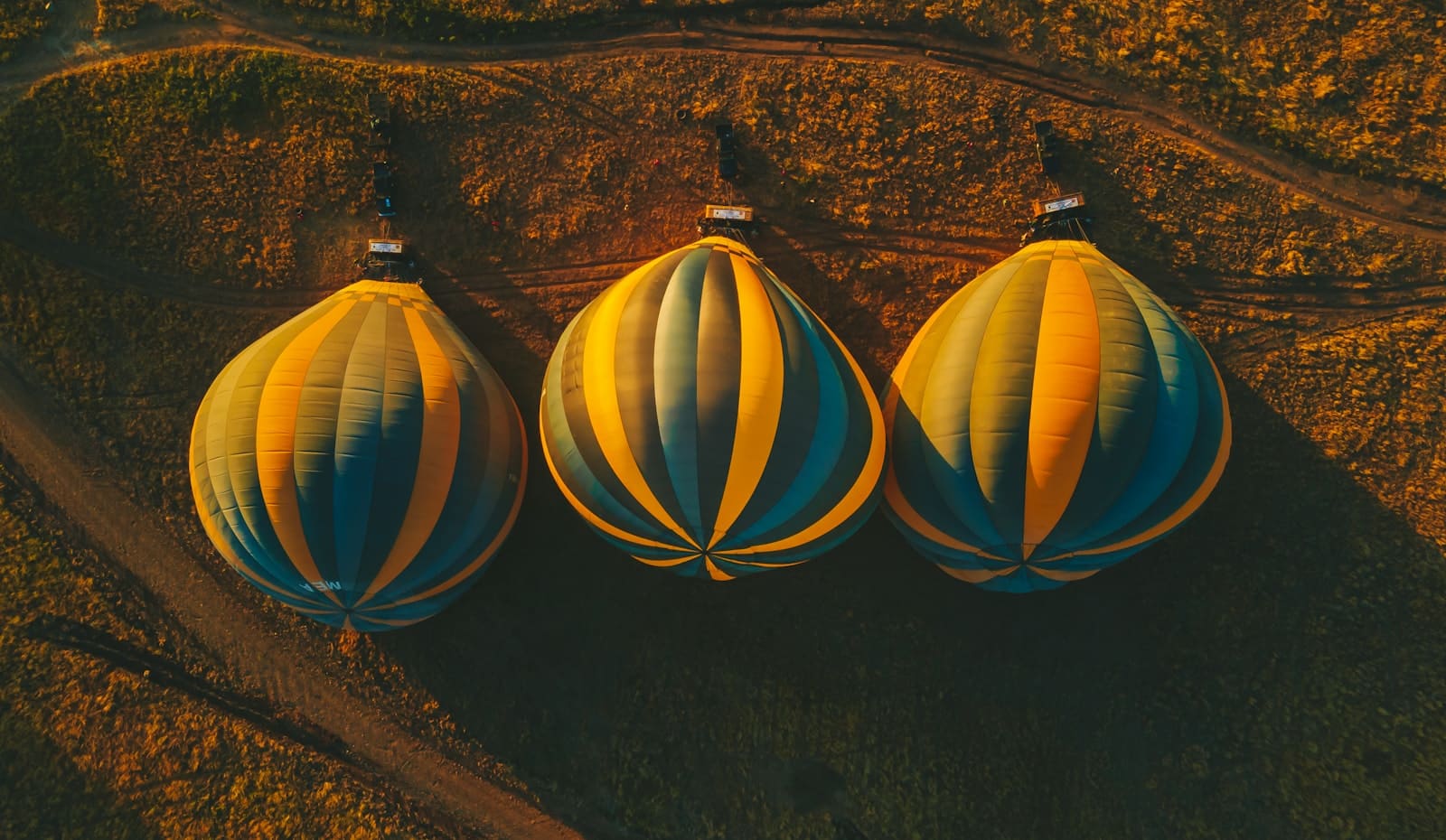
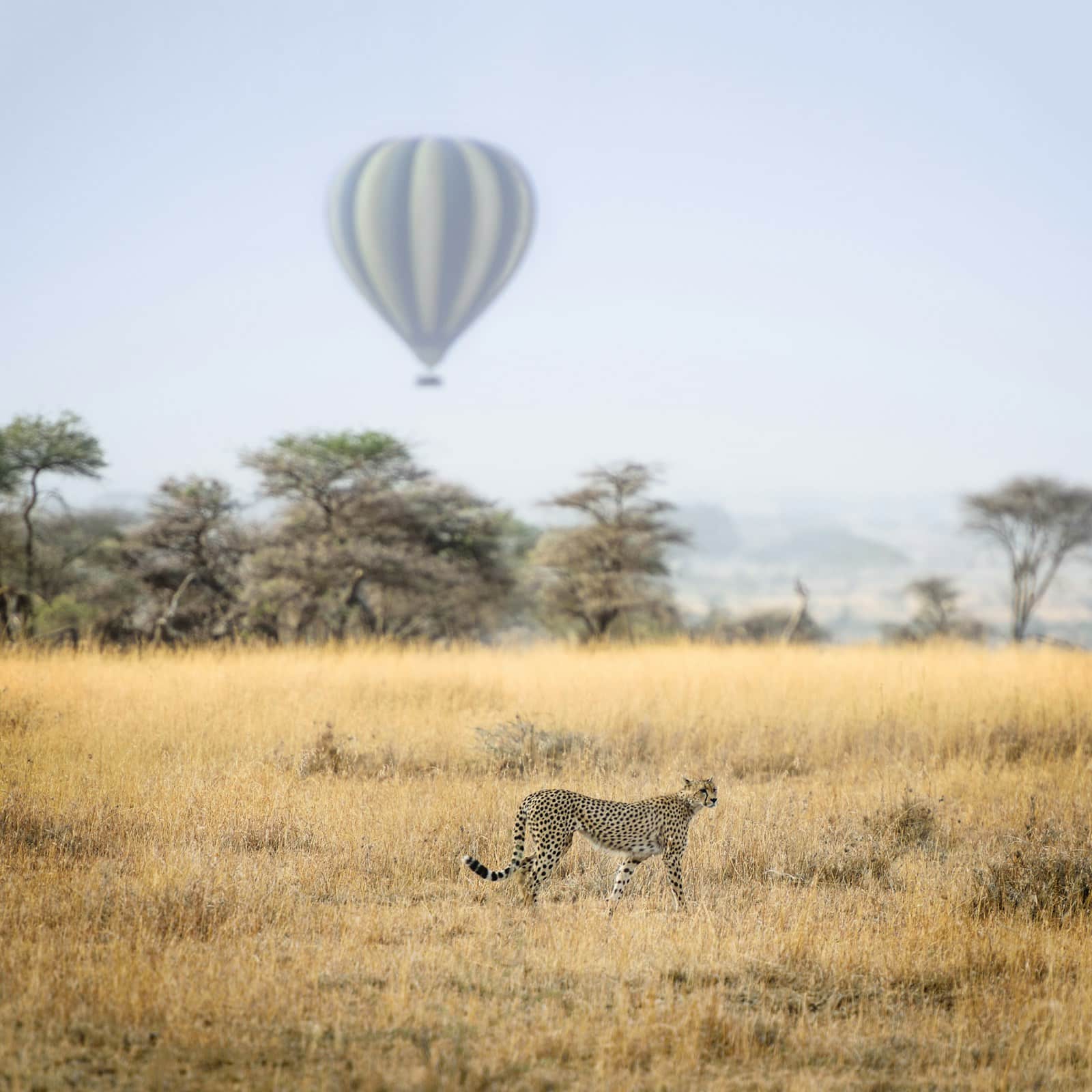
The envelopes go out on the grass in the dark; inflation starts as the sky lightensLooking down on the rest of the morning's balloons over the short-grass plainsThree balloons aloft over the central Serengeti; each carries up to 16 passengersInflation beside the Land Cruisers that collected everyone from their camps before dawnA cheetah crossing the long grass under a balloon; the animals rarely look upDrifting with the wind at first light; a flight covers 10 to 30 kilometers depending on the breeze
Who can fly
Children fly from six with Serengeti Balloon Safaris and from five with Miracle Experience and Adventures Aloft, in every case with a parent in the same compartment, and the two newer operators also ask for a minimum height of 1.2 meters so a child can see over the basket rim. Serengeti Balloon Safaris will look after younger children on the ground, with breakfast, at no charge while their parents fly. There is no upper age limit, but you must be able to climb into and out of a chest-high basket unaided and hold the landing position, so the operators decline pregnant passengers and advise against flying with recent surgery or a serious back or neck condition.
Weight matters because it is a balloon. The operators plan on an average of 80 kg per passenger and a passenger over 120 kg, including hand luggage, may be asked to pay for two places or a supplement, and should say so at booking rather than at the field. Dress for a cold start and a warm finish: layers, a fleece or jacket, long pants, closed shoes and a hat, because the burner above your head is hot. Cameras, phones and binoculars are all fine and there is nowhere to drop them, but a strap is sensible.
Weather is the pilot's call, not yours, and the call is made at the field. Balloons do not fly in wind above about 10 to 15 knots or in low cloud, which is why launches are timed for the calm hour after dawn. Cancellations are uncommon, and in every case you are refunded in full or offered the next morning.
Serengeti or the Masai Mara
The same herds cross into Kenya each July, and the Masai Mara has flown balloons since 1976, so clients often ask which side to fly. On price they have converged. Governors' Balloon Safaris, which launches from Little Governors' Camp in the Mara Triangle, publishes a 2026 adult rate of $490 for July to October, but Narok County adds a mandatory $80 landing fee, the community levy adds $20 and medical evacuation cover adds $5, so the real figure is about $595 in peak season and about $505 in April and May. Adventures Aloft publishes $499 from its Fig Tree Camp launch near Talek. The Serengeti's $599 is all in, and the difference at peak is a few dollars either way.
Pre-dawn inflation at Little Governors' Camp, the Mara Triangle launch site
The differences are in what you fly over. The Mara is a fraction of the Serengeti's size, so a Mara flight tends to cross the river, the escarpment and the plains in one hour and, in August and September, the crossing herds sit directly under the basket. The Serengeti flight is over a larger, emptier country, and which country depends on the launch site you chose above: river and woodland at Seronera, the Grumeti in the west, the Mara River and the Lamai plains in the north, a sea of short grass and newborn calves at Ndutu. The minimum age is eight in the Mara with Governors' and six in the Serengeti. If you are doing both countries on one trip, fly once, and fly wherever the herds are on your dates.
Tarangire and Ruaha
The Serengeti is not the only balloon in Tanzania. All three operators fly Tarangire all year at $550, and the flight is a different picture: baobabs, the Tarangire River and the elephant herds that make the park, with far fewer balloons in the sky and a much shorter pre-dawn drive because the park is compact. Ruaha, in the south, has a single balloon, operated by Serengeti Balloon Safaris, and you will usually be the only basket in the air over 20,000 square kilometers; the 2026 Ruaha rate is not published, so we confirm it when we quote. Neither replaces a Serengeti flight in migration season, but if your itinerary skips the Serengeti, Tarangire is the balloon to book.
Tarangire from the basket: the elephant park is the cheaper flight at $550
The Serengeti under you
What you are looking down on is 14,763 square kilometers of national park, inscribed as a World Heritage Site in 1981, inside an ecosystem of roughly 30,000 square kilometers that runs through the Ngorongoro Conservation Area, the Grumeti, Ikorongo and Maswa reserves and Loliondo and over the border into Kenya's Masai Mara. Tanzania National Parks gives the origin of the name as the Maasai word siringet, wide endless plains, and from 1,500 feet at dawn that is exactly what it looks like. The park was established in 1940 and took its present boundaries in 1951. The plains sit between 920 and 1,850 meters above sea level, which is why the mornings are cold enough for a fleece even on the equator.
The migration you are flying over is around two million wildebeest with several hundred thousand zebra and Thomson's gazelle, moving clockwise around the ecosystem every year: calving on the southern short grass plains from late January, north and west through the corridor in May and June, across the Grumeti and then the Mara River from July, and back south through the eastern woodlands in November. Our month-by-month migration guide puts the herds on a map; the launch sites above simply follow it.
Is it worth it
Our honest answer is yes for most people, once. For a couple it is $1,198 and a 04:30 alarm for one hour aloft, and that hour is the single most repeated memory our clients bring home from Tanzania, ahead of the crossings and the crater. The moment the burner goes quiet and you hear hyenas calling below you in the half light is not available any other way. We book it early in the Serengeti stay so a wind cancellation can be re-flown, in the site that matches the herds on your dates, and we book it months ahead for July to October and late January to February because the seasonal balloons sell out.
We would skip it for a family with children under six, for anyone who cannot manage the basket and for travelers on a tight budget who would rather put the $599 toward an extra night in a better camp, which in the Serengeti buys a great deal. And we would never make it the last morning of a trip. If it is the one activity you were unsure about, tell us your dates and we will tell you which launch site and which operator we would put you in.
Put a balloon in your Serengeti mornings
Tell us your travel dates and we will quote the flight from the launch site the herds will be under, with the camps and transfers around it, in one written price.
How much is a hot air balloon safari in the Serengeti?
+
$599 per person in 2026 with all three operators, for a shared basket, including the pre-dawn collection, about an hour in the air, a champagne toast and a cooked bush breakfast. Serengeti Balloon Safaris has published $660 from 1 January 2027. Park entry fees are separate and charged through your safari.
What time does a Serengeti balloon safari start?
+
Collection from camp is between about 03:10 and 05:15, depending on the distance to the launch field, with most pickups around 04:30. The briefing runs from about 06:15, the balloon lifts at around 06:45 and you are back with your guide at the Seronera Visitor Centre or an airstrip at about 09:45.
Can children go on a balloon safari?
+
Yes, from six with Serengeti Balloon Safaris and from five with Miracle Experience and Adventures Aloft, with a parent in the same compartment and, for the latter two, a minimum height of 1.2 meters. Serengeti Balloon Safaris offers free ground-based childcare with breakfast for younger children while their parents fly.
Where do the balloons launch in the Serengeti?
+
Four areas. Seronera in the centre all year; Kirawira and the Western Corridor roughly June to October; Kogatende and the Lamai Wedge in the north roughly June to October for the river crossings; and Ndutu on the southern plains from 20 December to 31 March for the calving season.
Is a balloon safari safe?
+
The Serengeti operators fly under Tanzania Civil Aviation Authority licenses, brief every passenger on the landing position, do not fly in wind above about 10 to 15 knots or in low cloud, and Serengeti Balloon Safaris retires each envelope after 950 flying hours. The main physical demands are climbing into a chest-high basket and bracing for a landing that can be a short drag in a breeze.
Is the Serengeti or the Masai Mara better for a balloon safari?
+
Prices are within a few dollars of each other at peak, about $595 all in for Governors' Balloon Safaris in the Mara Triangle against $599 in the Serengeti. The Mara flight is more compact and puts the crossing herds under the basket in August and September; the Serengeti offers four launch sites that follow the migration for about nine months of the year. Fly once, wherever the herds are on your dates.
Where are the best places for a balloon safari in Africa?
+
Six worth knowing, and Tanzania holds three of them. The Serengeti is the classic, with four launch sites that follow the migration for most of the year at $599; Tarangire is the quieter flight over baobabs and elephant herds at $550; and in Ruaha, the country’s second-largest national park, Serengeti Balloon Safaris flies the only balloon in the sky. Kenya’s Masai Mara is the other East African classic, with the crossing herds under the basket in August and September. In Namibia, Namib Sky has flown the Sossusvlei dunes since 1991, launching between Sesriem and Sossusvlei and in the NamibRand for about an hour at N$10,720 per person, roughly $600, with a desert breakfast and a sparkling-wine toast; it closes from 15 January to 15 February. The Okavango Delta has had a seasonal balloon from April to mid-October out of Vumbura Plains and Kadizora, but the operator’s website is offline and agents list the activity as suspended as we write, so we confirm it before promising it.
About the Author
Bhavita M.
Safari Specialist · Magical Africa
Bhavita has spent over a decade designing tailor-made journeys across East and Southern Africa, from the Serengeti to the Okavango. She writes from repeated first-hand experience of the destinations, camps and seasons described here.
Magical Africa is a registered travel advisory · CST 2150760-40 · Chino Hills, California
Tell us a little about your dream trip and one of our safari specialists will be in touch to start crafting your tailor-made itinerary.
Feel free to get in touch with us to begin planning your personalized dream safari today. Our team specializes in crafting bespoke safari experiences that cater to your specific preferences. Whether you’ve always dreamed of witnessing the Big Five in their natural habitat, marveling at the mesmerizing Great Migration, or simply savoring the enchanting African sunsets, we’re here to turn your safari dreams into reality.